

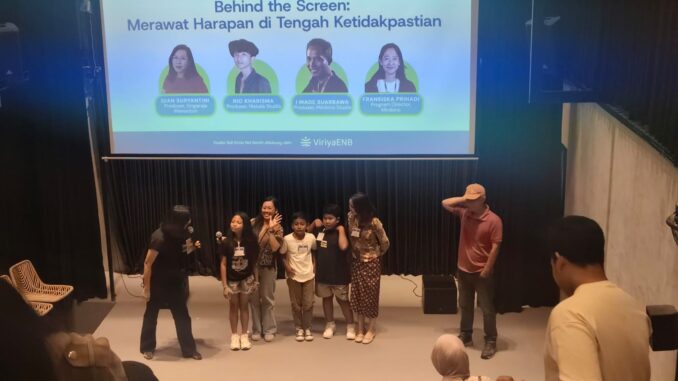
DENPASAR, mybalinews.com – The 2026 Bali Climate Week Folk Festival presents five short films that address environmental issues and the lives of the Balinese people. These include Memanen Matahari (Harvesting the Sun), Viewfinder (Viewfinder), Satu Pemberhentian Lagi (One More Stop), Dapur Laut (Sea Kitchen), and Berlayar (Sailing). Each presents a different storytelling approach to translate environmental issues into relatable human experiences for the audience.
The five films premiered at Flow Workspace, a low-emission area in Sanur, as part of the Bali Climate Lens program. This program is a short film fellowship that connects filmmakers with environmental issues and the experiences of communities in various regions of Bali through five works.
Memanen Matahari (Harvesting the Sun) producer, Ni Luh Dian Suryantini, explained that the idea for this film arose from the fact that solar panels are still unfamiliar to the public, including children living near the facility. Before production began, the team questioned their knowledge of solar panels. The results revealed that the children were unaware of what solar panels were or how the technology works.
“When we talk about big things, we want to simplify them. A big message is conveyed simply. That’s why we chose a children’s perspective,” said Dian after the Premiere of 5 Short Films from Lensa Iklim Bali and the screening of the film “Energy for the Nation” on Saturday (10/17).
This film highlights the use of solar panels in Bondalem Village, Buleleng, Bali. In this village, residents have no water sources such as mountain springs or rivers. Their water needs are met through drilled wells, with pumps powered by solar energy captured by solar panels.
From there, the children begin to understand the relationship between sunlight, electricity generation, and meeting the community’s basic needs. Children were chosen as actors and communicators because they were considered capable of translating complex energy issues into simple, honest, and easily understood stories across generations.
“The children are positioned not only as actors, but also as participants learning to understand technology in their own environment. They are invited to explore fundamental questions: where does the water the villagers use come from, and how does it get to their homes?” Dian concluded.
Behind the clean energy story lies the equally important issue of technology utilization. Dian mentioned that the solar panel facility at the site has been operating since 2017, with 77 panels and a capacity said to reach 20,000 watts (20 kilowatts).
The facility still functions to support the operation of the water pump. However, the system is not yet equipped with energy storage batteries. As a result, excess electricity generated when production exceeds current demand cannot be stored for later use.
Aisyah Madeleine, Communications Specialist for the Bali Net Zero Emissions Coalition, stated that the Bali Climate Lens is one way to broaden the conversation on climate action through a cultural and creative approach. She emphasized that climate issues are inseparable from the decisions and changes that occur in everyday life.
“When discussing the transition to net zero emissions, we also need to consider how those changes are perceived and felt by the community,” she said. (mybalinews/NAN)


Be the first to comment