

GIANYAR, mybalinews.com– Bali’s water crisis is not simply measured by the flow of water from household and hotel taps. Beneath the surface, groundwater reserves continue to be pressured due to overexploitation and reduced catchment areas.
This condition has triggered a decline in both water quantity and quality, even paving the way for seawater intrusion in several coastal areas.
IDEP Foundation Executive Director, Edward Angimoy, called this a water crisis that requires immediate action. Based on IDEP research in 2018, six to seven regencies/cities in Bali are experiencing a decline in water quantity and quality. Areas of concern include Badung, Denpasar, Karangasem, and Buleleng.
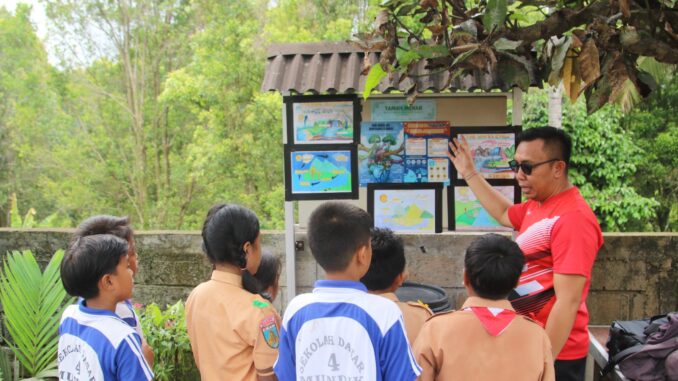
“If we call this a crisis, it’s because groundwater quantity is decreasing and its quality is also declining. This is due to overexploitation, exceeding the amount of water being put into the ground,” said Edward during the IDEP Foundation Innovation Tour BCW 2026 as part of Bali Climate Week, in Kemenuh, Gianyar, Friday (10/16).
Edward cited Bali as a balance sheet, where more water flows out than enters, further unbalancing Bali’s water balance. This situation is exacerbated by land conversion, which has eliminated natural catchment areas.
Forests, rice fields, fields, and open spaces that should help absorb rainwater are increasingly being squeezed by development. When the ground surface is covered by concrete and buildings, rainwater no longer has the capacity to infiltrate into groundwater reserves. Some of it flows onto the surface, increasing the risk of flooding.
“The abundant rainwater becomes flash floods. It’s a shame. It could actually be replenishing the groundwater,” he concluded.
The next threat is seawater intrusion, the intrusion of seawater into freshwater layers due to changes in the groundwater balance, triggered in part by excessive groundwater extraction. As a result, well water in coastal areas is at risk of becoming brackish or even salty and no longer suitable for consumption.
IDEP has identified the problem of seawater intrusion in several coastal areas, including Sanur. Edward cautioned that intrusion is not a static problem. If groundwater depletion continues, seawater has the potential to move further inland. Recovery could also take a long time.
“Once it happens, it will take a very long time to recover,” he said.
Water issues are not limited to underground reserves. Edward mentioned that IDEP research in 2018 found a decreasing trend in the discharge of Lake Buyan and Lake Beratan. Meanwhile, in Sanur, he noted that the decline in groundwater levels during the dry season can approach one meter, even reaching two meters in extreme conditions. These findings are data provided by IDEP and require regular monitoring to reflect the current situation.
Amid these threats, Edward criticized the lack of concrete action from stakeholders to improve water management. According to him, the water crisis often goes unnoticed because people can still get water from the tap. However, the current availability of water does not automatically guarantee the sustainability of groundwater reserves.
He emphasized that it would be inappropriate to solely focus on the tourism sector for this issue. Domestic water needs, economic activities, and the tourism industry all depend on water availability. Therefore, resolving this issue requires regulating water use, protecting catchment areas, and consistently enforcing policies.
One measure promoted by IDEP is the construction of recharge wells, which are wells designed to inject water into the ground to help replenish groundwater reserves. Unlike infiltration wells, which generally focus on water absorption, the term recharge well emphasizes the goal of recharging groundwater storage layers.
Edward encouraged the government to require recharge well construction plans as a requirement in the building permit process. According to him, this policy could be an instrument to reduce the imbalance between groundwater extraction and recharge, while still considering geological conditions, water quality, and technical feasibility.
He said that the depth of recharge wells can vary from around four meters to tens of meters, even reaching 50 meters, depending on soil conditions and regional characteristics. Therefore, their implementation must be based on technical studies, not simply to fulfill administrative requirements.
However, recharge wells are not the sole solution. These efforts need to be accompanied by protection of forests and catchment areas, control of land conversion, monitoring of groundwater extraction, and oversight of water resource utilization.
For Edward, the government cannot simply formulate policies without ensuring their implementation. Without measurable steps to maintain groundwater reserves and restore the function of catchment areas, Bali risks facing increasingly severe water problems, both for the community and for the sustainability of tourism.
The water crisis, therefore, is not simply a future threat. The decline in water quantity and quality reported by IDEP serves as a warning that Bali’s development must take into account the limits of environmental carrying capacity. If water continues to be extracted while the space for replenishment is increasingly limited, the flow of water from the tap today does not guarantee its availability in the future. (mybalinews/NAN)


Be the first to comment