

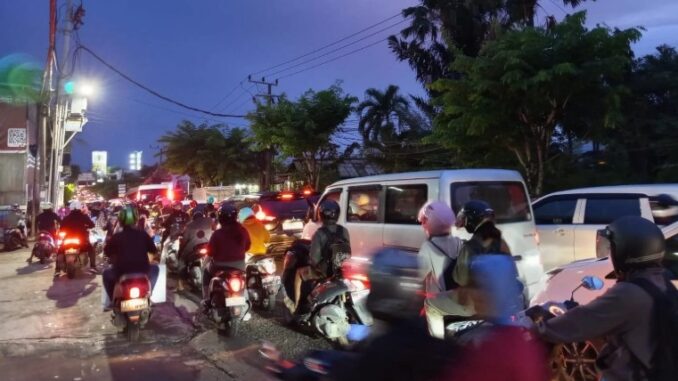
DENPASAR, mybalinews.com– The dominance of private vehicles in public mobility is a serious challenge for Bali as it pursues its net-zero emissions target High rates of motorcycle and car usage make the transport sector one of the largest contributors to emissions on the “Island of the Gods,” accounting for approximately 41 percent of emissions in 2024.
Haikal Zaldi, Transport Decarbonisation Project Lead at WRI Indonesia, notes that this situation demonstrates how Bali’s emissions issue is inextricably linked to public mobility patterns. As long as private vehicles remain the primary choice, the strain on the environment and air quality will continue to intensify.
“The significant share of private vehicles indicates that transport reform must be a crucial component of Bali’s emissions reduction strategy. The transition to public transport needs to be made easier, more comfortable, and more attractive to the public,” Haikal said during the Second Climate Week Workshop on Tuesday (October 6).
Data presented by WRI Indonesia shows that the number of vehicles in Bali reached 5,227,554 units in 2024—far exceeding the population of approximately 4.6 million. The vehicle count has also been growing at an average rate of about 5 percent annually over the past decade.
This dominance is evident in the travel modes chosen by the public. Motorcycles account for approximately 62 percent of travel, followed by cars at 33 percent. Meanwhile, heavy transport accounts for about 3 percent, and public transport for only 1 percent. This situation indicates that Bali’s mobility system still relies heavily on private motorized vehicles, as public transport options have yet to become a primary alternative for the public.
WRI Indonesia believes that shifting mobility patterns is key to cutting transport emissions. Strengthening public transport must go hand-in-hand with the implementation of Low Emission Zones (LEZ), thereby providing the public with lower-emission mobility options. “Public transportation is essential to reduce emissions from the transport sector in Bali, which account for around 40 percent of the total,” asserted Haiqal.
On the other hand, another challenge is the limited coverage of public transport in the Sarbagita region. Services such as Trans Metro Dewata, Trans Sarbagita, and Shuttle Intaran reportedly cover only about 10 percent of the Sarbagita area. Consequently, WRI is promoting the Bali Low Emission Zone Initiative (BLEZI) concept, which integrates transportation and spatial planning while fostering the involvement of businesses and the community.
“This approach is expected not only to curb emissions but also to transform urban spaces, making them more pedestrian-, cyclist-, and public transport-friendly,” he added. (mybalinews/IST)
Be the first to comment