

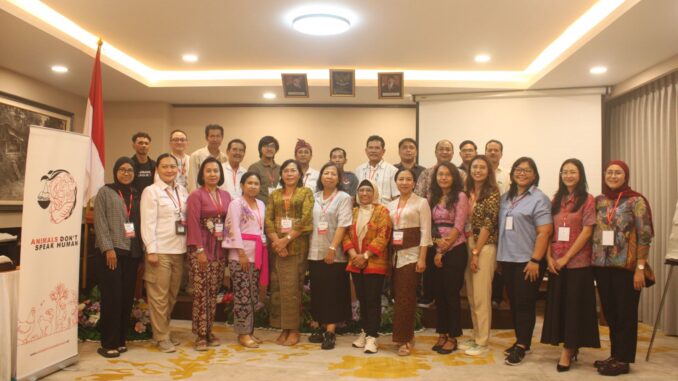
DENPASAR, mybalinews.id – Efforts to strengthen collaboration on animal welfare implementation in Bali’s laying hen farming system were highlighted in a Focus Group Discussion (FGD): Cross-Sector Collaboration to Promote the Transition to a Sustainable Livestock System in Bali, initiated by the Indonesian Animal Legal Protection Foundation (Animals Don’t Speak Human)—hereinafter referred to as ADSH.
This forum aims to bring together various stakeholders, including government, academics, civil society organizations, and business actors, to jointly examine the gap between national regulations and field practices, while also formulating strategic steps for more effective implementation at the regional level.
Legally, Indonesia already has a regulatory framework governing animal welfare, including Law Number 18 of 2009 in conjunction with Law Number 41 of 2014 concerning Animal Husbandry and Animal Health, and Government Regulation Number 95 of 2012 concerning Veterinary Public Health and Animal Welfare.
The latest strengthening comes through Minister of Agriculture Regulation No. 32 of 2025 concerning the Implementation of Animal Welfare, which provides technical instruments for local governments to implement animal welfare principles in livestock businesses.
However, the Scoping Report: Farmed Animal Welfare Implementation and its Impact Towards Environmental and Public Health in Bali, Indonesia, a joint project between ADSH and the Faculty of Veterinary Medicine at Udayana University, shows that the implementation of this regulation still faces several challenges. Most laying hen farms still use high-density battery cage systems. Furthermore, antibiotic monitoring, environmental management, and licensing aspects still require strengthening.
“The implementation of animal welfare provides benefits to consumers in the form of improved food quality and safety, to farmers in the form of efficiency, access to premium markets, and increased income, and to animals in the form of better living conditions free from stress and disease. However, implementation in the field still faces various challenges,” said Drh. Ni Ketut Aryani Parmeti, a member of the Bali Provincial Agriculture and Food Security Office.
This situation indicates that the implementation of animal welfare principles in livestock farming practices in the region still faces various challenges. On the other hand, Bali already has various regional policies governing development planning, spatial planning, and environmental protection. However, the integration of animal welfare principles specifically into regional policies governing laying hen farming systems still requires strengthening and more comprehensive development.
Through this FGD, stakeholders from the regional government, academics, civil society organizations, and business actors are expected to jointly identify implementation challenges and formulate contextual policy recommendations for Bali. This discussion is also expected to encourage the integration of Minister of Agriculture Regulation No. 32 of 2025 into regional policies, while strengthening cross-sector coordination in its oversight and implementation.
“Today, consumers are not only considering price, but are also starting to care about how food products are produced, including the treatment of animals. Global trends indicate a shift towards cage-free systems,” said Prof. Dr. drh. Pudji Astuti, Professor of the Faculty of Veterinary Medicine, Gadjah Mada University, who was present as a resource person at today’s event.
The ADSH Director stated that this forum is an important step in ensuring that animal welfare is not merely regulated but is actually implemented in practice.
“The transition to a sustainable laying hen farming system in Bali is inextricably linked to Bali’s commitment to sustainable tourism based on the Tri Hita Karana philosophy. The principle of harmony should also be reflected in the governance of the food system, including how we ensure the welfare of farmed animals is properly met. Through this forum, we see an opportunity to make animal welfare an integral part of Bali’s sustainable development, strengthening tourism competitiveness while maintaining environmental balance and public health,” said Fiolita Berandhini, ADSH Director.
Going forward, the results of this discussion are expected to form the basis for developing policy recommendations that support a more sustainable and responsible laying hen farming system that aligns with the principles of animal welfare, public health, and environmental protection.
“We hope that through this FGD, the results we obtain will not stop at the discussion stage, but will instead serve as the beginning of a collaborative movement toward a cage-free chicken farming transition in Bali,” said G. Febiola Sirait, legal advocate for ADSH and the chief organizer of today’s FGD. ( mybalinews/RLS )

Be the first to comment